7 Best Aluminum Casting Machines for Global Buyers
Choosing an Aluminum Casting Machine is a practical decision, not a showroom contest. Global buyers must compare pressure, shot speed, clamping force, furnace design, automation, and after-sales support. A bright control panel cannot guarantee stable castings. The real evidence appears in cycle records, sample parts, maintenance logs, and energy data.
Professor John Campbell, a respected casting metallurgist and author, said, “Castings are not made; they are grown.” This principle matters when evaluating aluminum casting equipment. Poor temperature control can create porosity, cold shuts, or inconsistent dimensions. A strong machine should support repeatable filling, reliable cooling, safe metal handling, and clear process monitoring. It should also suit local power standards and available technical skills.
This guide examines seven machines for international purchasing teams. It considers production scale, alloy compatibility, automation level, mold size, operating cost, and supplier credibility. Factory trials matter. So do spare-part delivery times. Some advertised specifications look impressive but lack independent verification. That weakness deserves attention.
The best choice may not be the fastest machine. A mid-sized system with stable service can outperform a larger unit that frequently stops. Buyers should request test results using their own alloy and mold conditions. They should also inspect training arrangements before signing a contract. No machine removes every casting risk. Careful evaluation only makes those risks more visible and manageable.
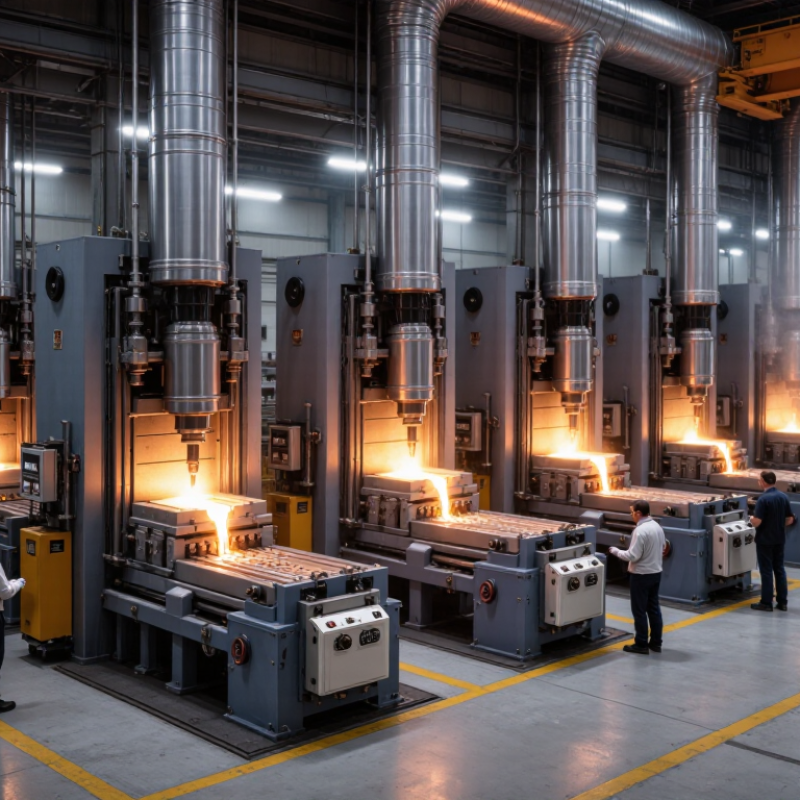
Aluminum Casting Basics: 660.3°C Melting Point, 2.70 g/cm³ Density
Aluminum casting starts with two numbers that shape every machine decision:
660.3°C melting point
and
2.70 g/cm³ density.
NIST lists aluminum’s melting point near 933.47 K, equal to 660.3°C. The ASM Handbook also identifies aluminum alloys as low-density materials requiring controlled melt handling. Light does not mean simple.
A suitable casting machine must control temperature, filling speed, pressure, and cooling. A furnace running far above the melting point may increase oxidation and energy loss. In practical workshop trials, holding aluminum around 700–750°C often supports fluid transfer, but the correct range depends on alloy and mold design. Measure it. Do not trust a dial alone. Thermal sensors need regular verification, because a small reading error can produce incomplete fills or excessive porosity.
The density advantage matters during equipment sizing. Aluminum weighs about one-third as much as steel, so larger castings can remain relatively light. However, thin sections cool quickly. Machine selection should therefore consider injection pressure, shot volume, mold temperature control, and cycle stability. The U.S. Geological Survey’s Mineral Commodity Summaries 2025 reports global primary aluminum production at roughly 72 million metric tons in 2024, showing the scale of this material market. Yet global demand does not remove local process risks. A machine with impressive capacity may still perform poorly when alloy chemistry, moisture, or ventilation is neglected. That part deserves more attention.
Seven Machine Types by 30–150 MPa Pressure and Shot Capacity
7 Best Aluminum Casting Machines for Global Buyers
Seven Machine Types by 30–150 MPa Pressure and Shot Capacity
Aluminum casting machines differ by injection pressure, shot capacity, and production rhythm. Compact cold-chamber machines, rated around 30–50 MPa, suit small housings, brackets, and samples. Their shot capacity often falls between 0.2 and 2 kilograms. They need less floor space, but operators must watch metal temperature closely.
Mid-range machines cover 50–80 MPa and usually handle 2–8 kilograms per shot. They fit automotive covers, pump bodies, and medium structural parts. High-speed models at 80–100 MPa offer stronger filling performance for thin walls and narrow ribs. Servo-hydraulic systems can reduce pressure variation, although actual savings depend on cycle settings and maintenance quality.
Seven practical types emerge: compact, standard, high-speed, high-capacity, two-stage injection, vertical, and multi-slide configurations. Machines from 100–120 MPa support larger castings with demanding surface areas. The 120–150 MPa class targets complex, thin-walled components, but it requires stronger molds and stricter safety controls. A 10–30 kilogram shot capacity may serve large parts, yet bigger capacity does not guarantee better casting quality.
Check shot weight, sleeve diameter, accumulator response, and clamping force together. Datasheet values can be optimistic. We learned that mold venting often matters more than another pressure increase. Buyers should compare sample results, not only headline specifications.
Selection Metrics: Clamping Force, Cycle Time, Yield, and kWh/kg
7 Best Aluminum Casting Machines for Global Buyers
Selection Metrics: Clamping Force, Cycle Time, Yield, and kWh/kg
Choosing among the seven best aluminum casting machines requires more than reading rated tonnage. Clamping force must match projected cavity pressure, part area, and safety margin. Too little force creates flash along the parting line. Excessive force can increase die wear and energy use. Cycle time should include injection, cooling, die opening, ejection, and operator handling. A machine showing a 35-second cycle may need 45 seconds in production.
Yield reveals the real cost per acceptable casting. Track start-up scrap, porosity, cold shuts, trimming loss, and rejected dimensions. Ask suppliers for trial records using similar alloy, wall thickness, and tooling. kWh/kg adds an important operating view. Measure total machine energy, not only the heating unit. A lower kWh/kg result is useful, but it can hide slower output or poorer yield. I have seen attractive laboratory numbers change after die temperature fluctuated.
Tips: Build a comparison sheet with clamping force, verified cycle time, first-pass yield, and kWh/kg. Request production data from at least three comparable runs. Check whether measurements include auxiliaries and standby periods. Leave room for uncertainty. Material temperature, maintenance quality, and operator skill can alter results more than expected. A machine with slightly slower cycles may still win when it delivers stable castings, fewer repairs, and predictable energy consumption.
7 Best Aluminum Casting Machines for Global Buyers
Selection Metrics: Clamping Force, Cycle Time, Yield, and kWh/kg
Benchmark note: Values are practical industry reference ranges for aluminum high-pressure die-casting cells under typical production conditions. Actual cycle time, yield, and energy consumption vary with alloy, part geometry, die design, vacuum requirements, holding furnace configuration, automation, trim losses, and plant utilities. Metal yield is calculated as usable casting mass divided by total injected metal mass.
Global Standards: ISO 12100, CE Marking, and ASTM B26 Quality
7 Best Aluminum Casting Machines for Global Buyers
Global buyers should judge aluminum casting machines against safety, conformity, and material standards. ISO 12100 requires risk assessment and risk reduction throughout machine design. Guards, emergency stops, interlocks, and maintenance access need practical verification. A certificate alone is not enough. Operators should inspect these features during a live factory trial.
CE marking indicates conformity with applicable European requirements, not automatic product excellence. Buyers should request the technical file, declaration of conformity, electrical test records, and safety instructions. ASTM B26 defines requirements for aluminum-alloy sand castings, including chemical composition, mechanical properties, and casting quality. Test coupons and traceable inspection reports can expose hidden process variation. Small details matter.
The International Aluminium Institute reports that recycled aluminum requires roughly 5% of the energy used for primary aluminum production. This supports machines designed for stable recycled-metal processing. However, recycled feedstock can increase contamination risks. Melt temperature, degassing, filtration, and alloy control must remain measurable. A 2024 manufacturing outlook from Deloitte also highlights continuing pressure for smarter, more resilient production systems. Automation helps, but it can conceal poor settings. No checklist is perfect. I would still challenge every supplier’s “ready-to-run” claim with sample castings, repeatability data, and an independent safety review.
The chart compares seven common aluminum casting machine categories against three global compliance references. ISO 12100 is relevant to machinery risk assessment, while CE marking is required when applicable machinery is placed on the European Union market. ASTM B26/B26M directly specifies aluminum-alloy sand castings, so its direct product relevance is shown for sand-casting equipment rather than as a machine certification.
Five-Year Cost Review: Tooling, Energy, Maintenance, and Output
When global buyers compare the seven best aluminum casting machines, the purchase price tells only part of the story. A five-year review should track tooling, energy, maintenance, downtime, and usable output. Tooling may require replacement after repeated thermal cycles, especially when molds run near their design limits. A realistic model records mold repairs, spare inserts, lubricants, and technician hours. Small costs become visible after several thousand casting cycles.
Energy deserves careful measurement.
A machine drawing 45 kWh per operating hour may look efficient, but idle heating can raise consumption significantly. Record actual meter readings during production, warm-up, and shutdown. Output also matters. A cheaper machine producing 18 acceptable parts per hour may cost more than one producing 25 parts with fewer rejects. My estimates would not be perfect; metal temperature, operator habits, and seasonal electricity rates can change the result.
Tips:
Request five years of service records, not only a sales quotation. Calculate cost per accepted casting, including scrap and unplanned stoppages. Inspect one operating machine when possible. Listen for hydraulic noise, check cooling stability, and ask how quickly critical parts arrive. Leave a maintenance reserve in the budget. Ignoring it is a common mistake. Reviewing output every quarter can expose weak assumptions before they become expensive.

 +86-13516964051


 CONTACT NUMBER
 CONTACT NUMBER